
A major petrochemical refinery in Louisiana struggled with inefficient separation in its distillation columns throughout 2022. Despite operating within design parameters, their existing random packing achieved only 78% of theoretical separation efficiency, resulting in increased energy costs and reduced throughput. After consulting with process engineers, they replaced standard rings with partitioned ceramic rings for chemical absorption towers, resulting in a 22% improvement in mass transfer efficiency, reducing energy consumption by 18%, and increasing throughput by 12% without any capital expansion investment.
This case demonstrates how partitioned ceramic rings improve mass transfer efficiency in real-world industrial applications. The partition design fundamentally changes fluid dynamics within chemical processing towers, creating superior performance that translates directly to operational savings and competitive advantages in the marketplace.
Understanding Partitioned Ceramic Rings and Their Design
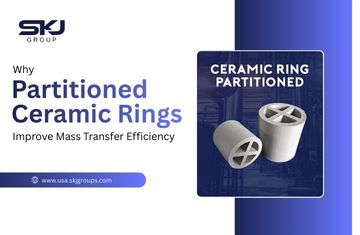
Partitioned ceramic rings for tower packing feature an internal dividing wall that splits the ring into two or more sections. This seemingly simple modification creates profound improvements in how liquids and gases interact within packed towers compared to traditional open rings. The partition increases the number of edges where liquid films form and spread across surfaces effectively.
As process liquid encounters these edges, surface tension forces distribute it more evenly across the packing bed. This maximizes the wetted surface area available for gas-liquid contact surface area enhancement in separation processes. Ceramic ring partitioned manufacturer USA companies engineer these partitions with specific thickness and positioning to optimize performance characteristics.
Key design elements of industrial partitioned ceramic rings in the USA include:
- Internal partition creates multiple flow channels within each ring
- Optimized partition thickness, balancing strength and void space
- Smooth ceramic surfaces promote complete liquid drainage
- Precise dimensional tolerances ensure consistent packing density
- Strategic partition placement maximizing liquid redistribution
- Chemical-resistant ceramic composition for extended longevity
How Partitioned Ceramic Rings Improve Mass Transfer Efficiency
1. Enhanced Liquid Distribution Mechanisms
Partitioned ceramic rings for tower packing dramatically improve liquid spreading compared to non-partitioned designs available in the market. The partition creates additional contact points where liquid divides into multiple streams, preventing the channeling that reduces efficiency in conventional packing systems. When liquid flows down through a packed bed, it naturally seeks the path of least resistance without proper distribution mechanisms.
Without partitions, liquid can bypass large portions of the packing, creating dry zones with zero mass transfer occurring. The partition geometry forces liquid redistribution at each ring level, ensuring uniform wetting across the entire tower cross-section. This enhanced distribution directly improves mass transfer efficiency by maximizing active surface area throughout the packed bed.
2. Increased Interfacial Surface Area
The gas-liquid contact surface area available for mass transfer increases substantially with partitioned designs offered by ceramic partition rings USA suppliers. Each partition edge creates locations where thin liquid films form, providing ideal conditions for rapid vapor-liquid equilibration in absorption and stripping columns. Research demonstrates that tower packing partitioned ceramic rings in the USA provide 20-30% more effective surface area than equivalent non-partitioned rings.
This increased area directly translates to improved separation efficiency or reduced packing height requirements in tower design applications. The partition effectively creates more interfacial surface without increasing overall packing volume or tower diameter significantly. High-efficiency ceramic tower packing leverages this geometric advantage to deliver superior performance across diverse applications.
3. Optimized Vapor Flow Patterns
While enhancing liquid distribution, industrial partitioned ceramic rings USA designs maintain excellent vapor distribution throughout the packed bed. The partition creates defined flow channels that promote even vapor distribution across the tower cross-section, preventing preferential flow paths that reduce mass transfer efficiency. The low-pressure drop performance of partitioned ceramic rings remains comparable to non-partitioned designs despite the internal obstruction.
Careful engineering ensures the partition enhances rather than impedes vapor flow through the packing bed during operation. The result is balanced gas-liquid contact with minimal energy penalty from pressure drop across the bed. Ceramic ring partitioned supplier USA products achieve this optimization through computational fluid dynamics and extensive pilot testing.
4. Superior Turndown Capability
Partitioned ceramic rings for chemical absorption towers maintain high efficiency across broader operating ranges than traditional packing designs. At low liquid rates where conventional packing struggles with poor distribution, the partition geometry continues spreading liquid effectively. This turndown flexibility proves valuable for processes experiencing variable feed rates or seasonal demand fluctuations.
The packing performs efficiently whether operating at 40% or 100% of design capacity, providing operational flexibility. This characteristic reduces the need for multiple packing zones or specialized distributors in variable-rate applications significantly.
Applications of Partitioned Ceramic Rings in Industrial Processes
1. Distillation Column Performance Enhancement
Industrial ceramic packing for distillation columns utilizing partitioned ceramic rings achieves sharper separations with fewer theoretical stages. This efficiency improvement allows debottlenecking existing columns or designing more compact new equipment that reduces capital costs. The best partitioned ceramic rings for distillation column performance combine optimal geometry with chemical resistance and thermal stability.
These characteristics enable use in applications from cryogenic air separation to high-temperature vacuum distillation across industries. The improved mass transfer efficiency translates to energy savings, increased throughput, or higher product purity depending on operational objectives. Tower packing partitioned ceramic rings USA provide long-term reliability in these critical separation processes throughout their service life.
2. Chemical Absorption Tower Applications
Partitioned ceramic rings for chemical absorption towers excel in acid gas removal, solvent recovery, and emission control applications. The enhanced gas-liquid contact surface area maximizes absorption rates, reducing tower height or increasing throughput capacity without equipment modifications. Corrosion-resistant packing media properties prove essential in absorption service where aggressive chemicals contact the packing continuously.
Partitioned ceramic rings withstand concentrated acids, caustics, and oxidizing compounds without degradation or performance loss over years. This durability ensures consistent performance throughout extended service in demanding chemical environments requiring reliable operation. Ceramic ring partitioned distributor USA networks supply these critical components to facilities nationwide.
3. Stripping Column Operations
In stripping applications where dissolved gases or volatile components transfer from liquid to vapor phases, partitioned ceramic rings provide the interfacial area needed for efficient operation. The geometry promotes thin liquid films ideal for the rapid desorption of volatile components from liquid streams. Mass transfer ceramic ring media optimizes both absorption and stripping processes through identical mechanisms.
The partition creates turbulence and spreading that enhances mass transfer regardless of the transfer direction in the tower. This versatility makes industrial partitioned ceramic rings USA products suitable for complex processes involving both absorption and stripping sections.
4. Environmental Scrubbing Systems
Pollution control scrubbers rely on efficient mass transfer to remove contaminants from waste gas streams before atmospheric release. Partitioned ceramic rings for tower packing maximize removal efficiency while minimizing pressure drop that increases operating costs. Environmental regulations demand high removal efficiencies that partitioned ceramic rings help facilities achieve reliably.
The corrosion-resistant packing media withstands the acidic conditions created when acid gases dissolve in scrubbing liquids during operation. Ceramic ring partitioned supplier USA companies provide solutions meeting both performance and regulatory compliance requirements.
Advantages Over Alternative Packing Types
1. Compared to Non-Partitioned Ceramic Rings
Standard ceramic rings without partitions provide good chemical resistance and thermal stability, but inferior mass transfer efficiency compared to partitioned ceramic rings. The partition modification typically improves efficiency by 15-25% without sacrificing other beneficial properties like chemical resistance. This performance improvement often justifies the modest cost premium for partitioned designs in efficiency-critical applications.
Ceramic partition rings USA suppliers offer both partitioned and non-partitioned designs, allowing customers to select based on application requirements. For new installations or retrofits targeting efficiency improvements, partitioned ceramic rings deliver measurable benefits.
2. Compared to Plastic Random Packing
While plastic packing costs less initially, industrial partitioned ceramic rings USA products offer superior temperature capability, chemical resistance, and service life. The efficiency advantage of partitioned ceramic rings often justifies the investment through improved process economics and reduced replacement frequency. Plastic packing degrades in high-temperature or chemically aggressive environments, where ceramic excels.
The low-pressure drop performance of partitioned ceramic rings matches or exceeds plastic alternatives while providing decades of service life. Total cost of ownership favors ceramic in most industrial applications despite higher initial investment costs.
3. Compared to Metal Packing
Metal packing corrodes in acidic or oxidizing environments where corrosion-resistant packing media are essential for reliable operation. Tower packing partitioned ceramic rings USA products maintain integrity indefinitely in services that destroy metal alternatives within months. The chemical inertness of the ceramic prevents contamination of process streams from packing corrosion products.
Metal packing also suffers from thermal expansion issues that ceramic materials avoid through low expansion coefficients. Ceramic ring partitioned exporter USA companies serve facilities worldwide requiring corrosion resistance that metal cannot provide.
4. Compared to Structured Packing
Structured packing provides excellent efficiency but costs significantly more than random packing for equivalent tower volume. Partitioned ceramic rings for tower packing bridge the performance gap, offering structured packing efficiency at random packing economics. Installation of random packing is also simpler and less sensitive to precise placement than structured packing.
The cost-performance balance makes partitioned ceramic rings attractive for retrofit applications where structured packing investment cannot be justified. High-efficiency ceramic tower packing delivers measurable improvements without the capital requirements of structured alternatives.
Material Selection and Specifications for Optimal Performance
Ceramic ring partitioned manufacturer USA companies offer partitioned ceramic rings in various ceramic compositions tailored to specific applications:
- Porcelain provides an excellent balance of properties for general applications
- Alumina delivers superior thermal stability for high-temperature service
- Stoneware offers exceptional acid resistance for corrosive environments
- High-purity ceramics serve pharmaceutical and food-grade requirements
- Specialized formulations meet unique process conditions
Standard sizes range from 15mm to 75mm diameter, with 25mm and 38mm being most popular for chemical processing towers. Size selection depends on tower diameter, with larger towers accommodating larger rings that reduce pressure drop. The relationship between tower diameter and packing size follows established engineering guidelines.
Material selection impacts both performance and cost, requiring evaluation of process conditions including temperature, pH, chemical composition, and operating pressures. Ceramic ring partitioned distributor USA technical teams assist with material selection based on specific application requirements.
Installation and Performance Optimization Best Practices
Proper installation of partitioned ceramic rings for tower packing maximizes performance benefits and prevents operational issues during startup. Rings should be loaded randomly in lifts to prevent orientation that could channel liquid or vapor flows through the bed. Support plates must distribute weight evenly to prevent crushing the lower packing layers under the weight.
Quality ceramic ring partitioned supplier USA networks provide loading services, ensuring optimal installation according to manufacturer specifications. Initial startup procedures should gradually increase liquid and vapor rates while monitoring pressure drop and efficiency parameters. This approach identifies any packing settlement or distribution issues before reaching full operating conditions.
Periodic inspection of industrial ceramic packing for distillation columns helps identify fouling, mechanical damage, or performance degradation requiring attention. Proper maintenance extends packing service life and maintains efficiency throughout the operational lifecycle.
Why Choose SJK USA for Partitioned Ceramic Rings
1. Manufacturing Excellence and Quality Control
As a leading ceramic ring partitioned manufacturer USA, SJK USA produces partitioned ceramic rings meeting the highest quality standards. Our precision manufacturing ensures consistent partition placement, smooth surfaces, and tight dimensional tolerances that maximize mass transfer efficiency. Every production batch undergoes rigorous testing for dimensional accuracy, mechanical strength, chemical resistance, and thermal stability.
Our quality management systems ensure consistency across production runs, delivering reliable performance that customers depend on. Ceramic ring partitioned exporter USA certifications demonstrate our commitment to quality, meeting international standards.
2. Comprehensive Product Range
Whether you need standard tower packing partitioned ceramic rings USA or custom designs for specialized applications, SJK USA offers solutions. Our product line includes multiple sizes, materials, and partition configurations optimized for different tower applications. From standard porcelain rings to high-purity alumina for demanding applications, we provide options.
Custom engineering services develop specialized partition geometries for unique process requirements where standard designs prove inadequate. Industrial partitioned ceramic rings, USA customers benefit from our flexibility in meeting specialized needs.
3. Technical Expertise and Application Support
Our chemical engineering team helps customers optimize high-efficiency ceramic tower packing selection and installation for maximum performance. When you buy partitioned ceramic rings for industrial tower packing in the USA from SJK, you gain access to decades of combined experience. We provide computational fluid dynamics analysis, pilot testing support, and full-scale installation guidance.
Our engineers work collaboratively with customer teams to ensure you achieve maximum mass transfer efficiency improvements. Post-installation support helps optimize operating parameters for the best results.
4. Distribution Network and Global Reach
As both a manufacturer and a ceramic ring partitioned distributor in the USA, SJK USA maintains inventory locations nationwide, ensuring fast delivery. Our position as a ceramic ring partitioned exporterin the USA serves international customers requiring American-quality products with global logistics support. Strategic partnerships enable us to serve customers across six continents.
Our supply chain management ensures product availability when customers need it, minimizing project delays. Ceramic partition rings USA reliability matters when production schedules depend on timely delivery.
FAQ’s About Partitioned Ceramic Rings
1. How do partitioned ceramic rings improve mass transfer efficiency?
Partitioned ceramic rings increase liquid spreading and gas-liquid contact surface area, enhancing mass transfer rates significantly.
2. What efficiency improvement can I expect from partitioned rings?
Partitioned ceramic rings for tower packing typically improve efficiency by 15-25% compared to non-partitioned equivalents in applications.
3. Are partitioned ceramic rings more expensive than standard rings?
Yes, but improved mass transfer efficiency and low-pressure drop performance provide compelling return on investment.
4. What sizes of partitioned ceramic rings are available?
Ceramic partition rings USA suppliers offer sizes from 15mm to 75mm in diameter for various tower applications.
5. Can partitioned ceramic rings handle corrosive chemicals?
Absolutely, corrosion-resistant packing media properties withstand virtually all acids, alkalis, and organic solvents without degradation.
6. What temperature range do partitioned ceramic rings tolerate?
Industrial partitioned ceramic rings USA products handle temperatures from -50°C to 1400°C, depending on ceramic composition.
7. How long do partitioned ceramic rings last?
Tower packing partitioned ceramic rings USA products typically last 10-15 years in corrosive service applications properly.
8. Are partitioned rings suitable for all tower applications?
Yes, partitioned ceramic rings for chemical absorption towers excel in distillation, absorption, stripping, and scrubbing operations.
Conclusion
Partitioned ceramic rings for tower packing represent a significant advancement in mass transfer ceramic ring media technology, delivering measurable results. Their enhanced liquid distribution, increased gas-liquid contact surface area, and low-pressure drop performance deliver efficiency improvements translating to reduced operating costs. Combined with the inherent advantages of corrosion-resistant packing media, partitioned ceramic rings provide optimal solutions for demanding chemical processing towers. Partnering with a trusted ceramic ring partitioned manufacturerin the USA, like SJK, ensures access to premium high-efficiency ceramic tower packing products backed by expert technical support for achieving maximum performance improvements in your facility.
