
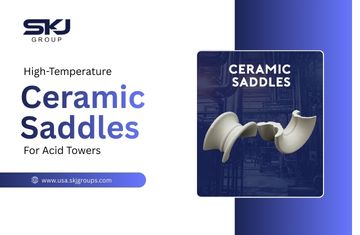
In 2023, a Texas sulfuric acid facility faced recurring equipment failures in its absorption towers. Plastic packing deteriorated within six months due to 95% acid concentration and 200°C temperatures. After switching to high-temperature ceramic saddles for sulfuric acid absorption towers, the plant achieved 18 months of continuous operation, reducing maintenance costs by 67% and improving efficiency by 12%.
Ceramic saddles represent critical components in modern chemical processing infrastructure. These ceramic saddles packing elements serve as tower packing material in acid towers where conventional materials fail under extreme conditions.
What Are Ceramic Saddles and How Do They Work?
Ceramic saddles are uniquely shaped packing elements manufactured from high-purity ceramic materials such as alumina, porcelain, or stoneware. The distinctive saddle shape provides optimal surface area for liquid-gas contact while maintaining low-pressure drop characteristics essential for efficient mass transfer.
These industrial ceramic saddles, USA products, function by creating turbulent flow patterns within industrial process towers. As process fluids pass through packed beds of ceramic saddles for distillation, the saddle geometry promotes intimate contact between liquid and vapor phases, maximizing transfer rates.
Key features of ceramic saddle packing USA elements include:
- Curved surfaces distribute liquid evenly across the tower cross-section
- Open void spaces allowing unrestricted vapor flow
- Balanced design ensuring consistent performance across varying conditions
- Optimized geometry, preventing channeling and promoting uniform wetting
Superior Advantages of High-Temperature Ceramic Saddles
1. Exceptional Chemical Resistance
Acid-resistant ceramic saddles for chemical processing plants offer resistance to virtually all acids, alkalis, and organic solvents. Unlike metal packings that corrode or plastic packings that degrade, corrosion-resistant ceramic packing media maintain structural integrity when exposed to concentrated sulfuric acid, hydrochloric acid, or nitric acid continuously.
The chemical inertness of ceramic tower packing for sulfuric acid plants means zero contamination of process streams. This purity is essential in pharmaceutical manufacturing and food processing applications.
2. Extreme Temperature Capability
High-temperature ceramic saddles for acid towers withstand operating temperatures from cryogenic conditions up to 1400°C, depending on ceramic composition. This thermal stability enables use in high-temperature distillation processes, thermal oxidation systems, and applications where temperature extremes destroy alternative packing materials quickly.
The low thermal expansion coefficient prevents cracking or warping during temperature cycling. This dimensional stability ensures consistent packing density throughout the equipment lifecycle.
3. Enhanced Mass Transfer Performance
The unique geometry of ceramic saddles for towers creates a high specific surface area while maintaining excellent void fraction. This combination delivers superior mass transfer efficiency compared to random packings with simpler geometries like rings or Raschig rings for separation duties.
Ceramic tower packing saddles promote even liquid distribution, preventing channeling. This ensures maximum utilization of available packing volume.
4. Long Service Life Benefits
While industrial ceramic saddles USA products have higher initial costs than plastic alternatives, their extended service life provides compelling total cost advantages. In corrosive acid service, ceramic saddles packing typically lasts 5-10 years, whereas plastic packings require frequent annual replacement.
The mechanical strength resists breakage during installation and operation. This durability reduces maintenance frequency and downtime costs.
Key Applications of Ceramic Saddles in Chemical Processing
1. Sulfuric Acid Production
Ceramic tower packing for sulfuric acid plants plays a vital role in both acid production and concentration processes. In absorption towers where sulfur trioxide reacts with water, high-temperature ceramic saddles for sulfuric acid absorption towers handle temperatures up to 220°C and acid concentrations approaching 98% safely.
2. Hydrochloric Acid Recovery
HCl recovery towers utilize ceramic saddles for distillation to separate hydrochloric acid from metal chloride solutions. The excellent acid resistance and thermal stability enable efficient operation in demanding applications.
3. Environmental Control Systems
Acid gas scrubbers and fume absorption towers in pollution control rely on acid-resistant ceramic saddles for chemical processing plants to remove harmful emissions. Whether treating SOx, NOx, or chlorine compounds, ceramic saddles for towers provide the chemical resistance needed for regulatory compliance consistently.
Selecting the Right Ceramic Saddles
1. Size Selection
Ceramic saddles are available in sizes ranging from 15mm to 100mm, with 25mm, 38mm, and 50mm being most common for acid tower applications. Larger towers benefit from larger packing sizes, reducing pressure drop while maintaining adequate surface area for separation.
The relationship between tower diameter and packing size follows industry guidelines. For optimal performance, the ceramic saddle packing diameter should not exceed one-eighth tower diameter.
2. Material Composition
Industrial ceramic saddles USA manufacturers offer various ceramic formulations:
- Porcelain provides excellent all-around performance at a moderate cost
- Alumina-based saddles offer superior thermal stability for high-temperature applications
- Stoneware compositions balance chemical resistance with mechanical strength
- High-purity ceramics serve pharmaceutical and food-grade requirements
A qualified ceramic saddles manufacturer in the USA can recommend optimal composition based on temperature, pH, concentration, and operating parameters.
Why Choose SJK USA for Ceramic Saddles
1. Manufacturing Excellence
As a leading ceramic saddles manufacturer in the USA, SJK USA combines advanced ceramic engineering with rigorous quality control. Our manufacturing facilities utilize precision forming techniques, delivering consistent dimensions and superior mechanical properties across production batches.
Every batch undergoes comprehensive testing for chemical resistance, thermal stability, and mechanical strength before shipment to customers.
2. Comprehensive Product Portfolio
Whether you need standard ceramic saddles packing or custom formulations for specialized applications, SJK USA offers a breadth of options meeting requirements. Our product line includes multiple sizes, materials, and grades suitable for basic distillation to demanding applications.
3. Technical Support
Our chemical engineers provide expert guidance on packing selection, tower design, and troubleshooting. When you buy ceramic saddles online from SJK USA, you gain access to decades of combined experience in tower packing material applications.
4. Distribution Network
As both manufacturer and ceramic saddles distributor in the USA, SJK USA maintains strategic inventory locations nationwide. This distribution capability ensures fast delivery for scheduled maintenance or emergency replacements.
Our position as a ceramic saddles exporter in the USA serves international customers requiring American-quality industrial ceramic saddles and USA products globally.
FAQ’s About Ceramic Saddles
1. What temperature range can ceramic saddles withstand in acid towers?
High-temperature ceramic saddles handle -50°C to 1400°C depending on composition, suitable for all industrial applications.
2. How do ceramic saddles compare to plastic packing?
Acid-resistant ceramic saddle packing outperforms plastic with superior chemical resistance, longevity, and temperature capability significantly.
3. What size ceramic saddles should I use?
Ceramic saddle packing USA sizing depends on tower diameter; consult the manufacturer for optimal selection criteria.
4. Can ceramic saddles be cleaned and reused?
Yes, ceramic saddles for chemical plants withstand aggressive chemical cleaning and provide multiple service cycles.
5. How long do ceramic saddles last in acid service?
Ceramic tower packing for sulfuric acid plants typically lasts 5-10 years under normal operating conditions.
6. What is the pressure drop across ceramic packing?
Ceramic tower packing saddles provide 100-400 Pa/m depending on size, depth, and flow rates.
7. Are ceramic saddles suitable for pharmaceutical applications?
Absolutely, ceramic saddle packing USA meets FDA and GMP standards for food-grade and pharmaceutical processing.
8. How do I properly install ceramic saddles?
Load ceramic saddles packing in lifts using distribution devices to prevent breakage during installation.
Conclusion
Ceramic saddles represent the gold standard for acid-resistant ceramic saddle packing in demanding industrial applications. Their exceptional chemical resistance, extreme temperature capability, and superior mass transfer efficiency make them indispensable for ceramic tower packing for sulfuric acid plants and chemical processing operations. While initial investment exceeds plastic alternatives, the extended service life and reliability of high-temperature ceramic saddles for acid towers deliver compelling total cost advantages. Partnering with a trusted ceramic saddles manufacturer in the USA, like SJK, ensures access to premium industrial ceramic saddles USA products, expert technical support, and dependable supply chain performance for critical tower packing applications.
